Powered by Blogger.
RSS

Welcome

I created this blog as an instrument of what I have encountered in the world of veterinary medicine as a proud vet student. Comments and suggestions are welcome here at;

sweet_daffodil90@yahoo.co.uk

Regards,
Aina Meducci 2012

Disclaimer

The following blog posts is not genuinely from my research but through readings and citation from trusted website. I do not own any of the copyright and therefore you may use it at your own risk

SINCE I AM NOT A VETERINARIAN YET, THEREFORE I CAN'T CONSULT ANY MEDICAL ADVICE TO YOU AND YOUR PETS! EXTREMELY IMPORTANT!.

Happy reading!
Showing posts with label cat. Show all posts
Post Icon

Cardiopulmonary resuscitation (CPR) in animal

Animal CPR (a big LOL)

During anesthetic class, we were taught to perform CPR on emergency anesthesia. This will not happen if the anesthetists are very careful in monitoring the patient throughout surgical period. So, let's dive in!

**********************************************************


CPR in dog


CPR is an emergency technique used to help someone whose heart and/or breathing has stopped. Although somewhat modified, the same techniques used for people – rescue breathing and chest compression – can be used to help treat an animal in distress.

The first lesson to know about CPR is that it doesn't restart a stopped heart. The purpose of CPR, in both humans and animals, is to keep them alive until the heart begins beating on its own or a cardiac defibrillator can be used. In animals, CPR is frequently unsuccessful, even if performed by a trained veterinarian. Even so, attempting CPR will give animal fighting chance.


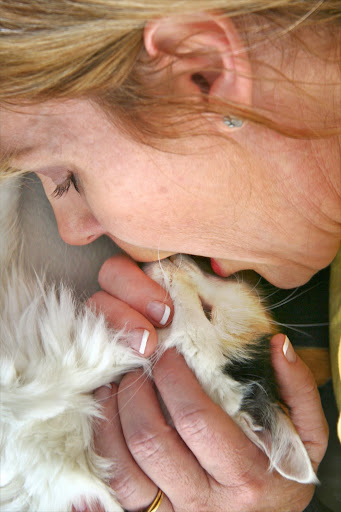
PCR on cat


At first, we must know the ABC rules!


A-Airway
1.Listen and feel to determine if your pet is breathing/has a pulse.
2.Carefully pull the tongue straight out of the animal’s mouth to open the airway
3. Make sure that the neck is reasonably straight; try to bring the head in-line withthe neck.

WARNING: Do not over-straighten the neck in cases where neck/head trauma exists

4. Attempt 2 rescue breaths, by closing the mouth, and performing mouth-to-nose ventilations. If they go in with no problems continue to B-Breathing.
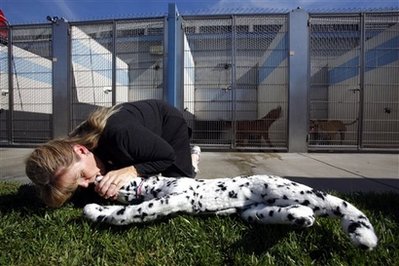
Step 2: Place pet on his right side (legs away from you)...
Opening airway in dog

See above for positioning to give breaths to a cat.

Opening airway in cat

5. If not, reposition the neck and try5. step 3 again.

6.Visibly inspect the airway by looking into the mouth, and down the throat for foreign objects occluding the airway. Unlike human-CPR, rescuers may reach into the airway and remove foreign objects that are visible.

6. If you still can’t breath into the animal,proceed to the Heimlich maneuver.

Heimlich maneuver

Use to remove choking material that cause inability in breathing

1. Turn the animal upside down, with its back against your chest 2. Hug the animal with your fist in your hand, just below the rib-cage ( for cats, just squeeze 1 hand in the same place)


2. With both arms, give 5 sharp thrusts (bear hugs) to the abdomen. Perform each thrust as if it is the one that will expel the object

3. Stop, check to see if the object is visible in the airway, if so, remove it and give 2 mouth-nose rescue breaths. If the breaths do not go in, go back to step 1


Heimlich maneuver


B-Breathing

After achieving a patent airway, one must determine whether the animal is breathing, and whether this breathing is effective:

1. Carefully pull the tongue straight out of the animal’s mouth to open the airway

2. Make sure that the neck is reasonably straight; try to bring the head in-line withthe neck.

3. Breathe at 12 breaths per minute (1 every 5 seconds)With each breath just make the chest rise (do not overinflate, expecially on a small animal)

IMPORTANT: If the breaths do not go in, stop and return to A-Airway!


Proceed to C-Circulation, while continuing breathing support as necessary.


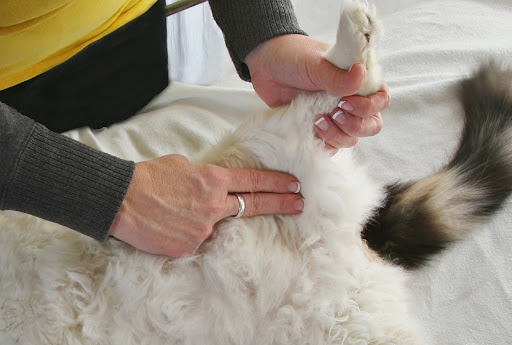
Check the femoral pulse!
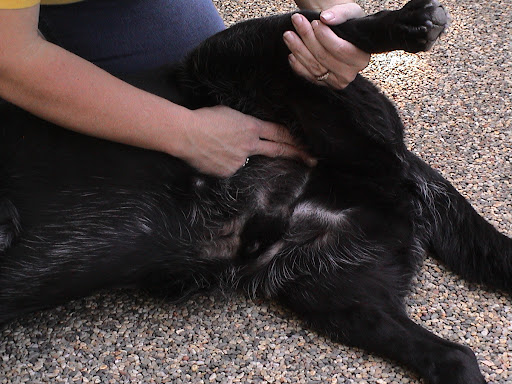
Step 3 (Dog): Check pulse at femoral artery (where hind leg meets torso), If no pulse…

Dog

Step 3 (Cat): Check pulse at femoral artery (where hind leg meets torso), if no pulse…

Cat


C- Circulation

This is the final step of CPR and should only be started after the A-airway and B-breathing steps have been completed:

1. Make sure that there are no major (pooling/spurting blood) points of bleeding. Control as necessary by applying pressure with your hand

2. Check for a pulse in the groin (check carefully on a conscious dog or cat!)

3. Lay the animal on its right side

Step 4 Gently take animal’s left front leg and bend it at the elbow, rotating it at the shoulder.  Where his elbow touches his body is where you place your left hand for compressions.


4. Locate your hands where its left elbow touches the chest, approximately the middle of the rib-cage (for cats use 1 hand in asqueezing motion).
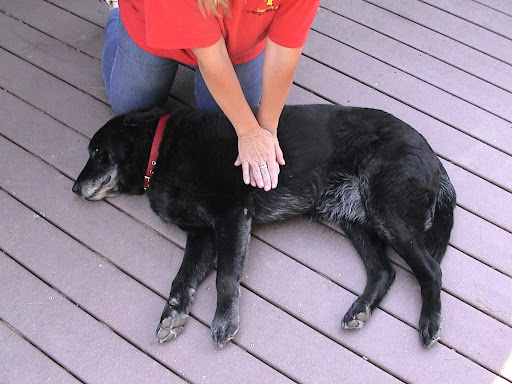
Compressions for medium to large dogs: With you left hand, push on the chest 10-15 times (approximately 3 compressions every 2 seconds) and then deliver 2 more breaths. Repeat.  Every 4 cycles, check for a pulse.


Location of heart

Compress the chest 15 times followed by 2 rescue breaths (3 compression every 2 seconds). Deliver 2 more breath. Repeat. Every 4 cycle for a pulse.
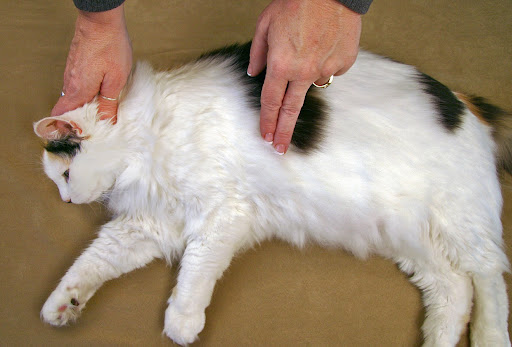
Compressions for small cats and dogs:  Use fingertips to compress heart in place of your left hand or place 4 fingers of your left hand under the animal’s chest and compress on the top with left thumb: 5 compressions/1 breath and check for a pulse every 8-10 cycles.

Compression for small cats and dogs: Use fingertips to compress heart in place of your left hand or place 4 fingers of your left hand under the animal’s chest and compress on the top with left thumb: 5 compression/1 breath and check for a pulse every 8-10 cycles.

If there are two people, one breathes and the others compresses at the rate of one breath for every 2-3 compression


After the CPR is successfully performed, quickly send the animal to the nearest vet!


Precaution in CPR

1. Take care not to over inflate the lungs, observe that you ventilate with a normal rise and fall to the chest.

2. Never breathe or compress on an animal that is breathing or has a pulse.

3. When doing compression, realize you must compress 1/4 to 1/3 the width of the chest. You must flex the ribs, press the lungs in order to squeeze the blood out of the heart and release so that it can flow around and back into the other chamber.

4. For barrel-chested breeds, you may position dog on his back and compress chest human-style (hand on top of hand over chest): 15 compressions/2 breaths checking for a pulse every 4 cycles.
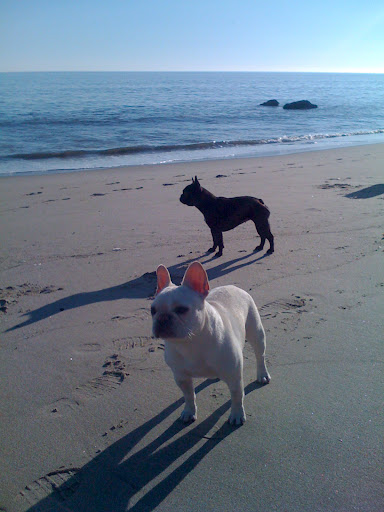
For barrel-chested breeds (like Fala and Winnie above) you may position dog on his back and compress chest human-style (hand on top of hand over chest):  15 compressions/2 breaths checking for a pulse every 4 cycles.

Barrel-chested dog


**Perform CPR until you have reached a veterinary hospital. After 20 minutes, however, the chances of reviving an animal are extremely unlikely.


Maybe you can learn something here..


Sources: Sheraton luxuries; CPR guide, CPR in dogs;petplace.com, dailywag; Martha steward.com; Pet first aid

  • Digg
  • Del.icio.us
  • StumbleUpon
  • Reddit
  • RSS
Post Icon

Cat's Mange (scabies)

I was appointed as a leader in small animal clinic section during our Faculty Open day in conjunction with World Veterinary Day this 24-25th June. We were decided to do "Cat Adoption" program to the visitors whom are interested in cats as well as to teach them to handle the cats and also encouraging them to send their cats to vet whenever their cat has medical problems. I managed to find 4 cats (2 of them kitten) for adoption. However, there is one cat which are positive to mange and need to give treatment before it affects other cats!

********************************************************


Cat's mange

Cat Mange is a skin disorder caused by mites skin. It is uncommon in cats but can occur. Mites can cause a localize from of the condition that starts on the ear, face and neck. Left untreated it can spread throughout the body and become what is known as a generalized form of the condition. Common symptoms include itch, dandruff, hair loss and sores. Treatment is with a lime-sulfur dip and prescription medications.

Cat mange is caused by two types of mites, burrowing mites and non-burrowing mites. Burrowing mites burrow in your cat's skin forming tunnels in which they lay their eggs. Larvae emerge, develop to nymphs then adults. The non-burrowing mites feed on skin scales; some suck tissue fluid and several suck blood.


A cat scratching due to mange


Types of Cat Mange

1. Ear mites (Otodectes Cynotis)

Ear mites are the most common form of mange in cats. The mites feed on scaling skin. This is a different condition from head manage and is caused by a different type of mite that does not burrow into the skin. Common symptoms include irritation and inflammation of the ear canal. In severe a substance oozing from the ear and red, scaly skin from secondary infections caused by bacterial or fungal infections.


Otodectes Cynotis mite


A cat having a ear mite

Cats that are afflicted with ear mites will typically scratch at the ears excessively and shake their heads, even pulling out their own hair and drawing blood as they scratch. Some cats will shake their heads so much that an hematoma of the ear will form (with blood pooling in the ear due to breakage of a blood vessel). Also of concern is when cats scratch at their ears to the point that injury is done to the ear canals or ear drums.

Symptoms

  • Itching of the ears, head and neck
  • Sometimes generalized itching
  • Excessive scratching at ears and around head
  • Frequently shaking the head
  • Thick red-brown or black crusts in the outer ear
  • Coffee ground like bumps in the ear canal
  • Abrasions and scratches on the back side of the ears
  • Crusting and scale on the neck, rump and tail


2. Notoedric Mange (head mange/ cat scabies)

This type of mange causes hair loss and crusty skin from mites burrowing under the skin. It is very itchy and causes cats to scratch excessively. The scratching can cause sores and bleeding of the skin. This form of mange is very contagious and can spread to humans or other animals.


Notoedres cati mite


A cat with notoedric mange


Notoedres can infect cats of all ages, breeds, and colors. It infects both males and females and often will infect an entire litter of kittens. Because this mite is transmitted directly from cat to cat, it is more common in outdoor cats that come in contact with strays. The mite only lives a few days off of the cat, but transmission through grooming, boarding, and sharing bedding is possible. N. cati can also infest foxes, dogs and rabbits.


Symptoms

The symptoms usually start with hair loss and itching on the ears and then spreads rapidly to the face, eyelids, and neck. The mites can also spread to the feet and lower abdomen. This characteristic spread probably occurs from the cat's habit of grooming, and sleeping curled up in a ball.

As the disease progresses, the skin will become thickened, wrinkled, and covered with grayish/yellowcrusts. Because of the intense itching, the infected cat will often scratch and irritate the skin causing secondary infections to develop. The surrounding lymph nodes may also become enlarged as the problem worsens.


Rare forms of mange in cats

3. Demodectic mange

This type of mange causes hair loss and small red, inflamed patches of skin. It may be localized, meaning it is restricted to a small area of the body, or generalized, meaning that it covers a large portion of the body. In severe cases, a bacterial skin infection may occur. This condition is rare in cats.


Demodex mite usually affect dogs


A demodectic cat (rare)


4. Cheyletiella Mange (walking dandruff)

Caused by a large red mite on the skin that produces flaking that looks like dandruff. Symptoms are usually seen on the back, neck and sides and include itching and red raised bumps. Although rare in cats, it is highly contagious for humans and other animals.


Cheyletiella mite


Cheyletiella blakei in cat (Cheyletiellosis)

Cat and dogs do not pass this type of mange to each other. Generally cats and dogs have small amounts of these mites inhabiting on their skin. This type type of mange does not often bother the cat unless it becomes inflamed. It might show up as small patches of hair loss. In more serious cases, it can cause in a bacterial infection on the skin. The skin can become inflamed, red and itchy. Demodex Mange usually starts causing problems in cats that are immuno-suppressed or that are aging. This type of mange can also adversely affect cats with poor health. Hormones and stress might also cause this type of mange to cause problems. It can be seen in pregnant and nursing cats or male cats that are not neutered.


5. Chiggers (Thrombiculid mites)

The mites look like red, orange or yellow spots on the skin. Symptoms are red sores, scabs and raw skin.


6. Sarcoptic Mange

Sarcoptic mange is another form of mange that can be contracted by felines. This variety of mange is highly contagious and very problematic to persistent. Cat that are affected by this variety of mange are extremely itchy and the scratching can cause serious inflammation and sometimes bleeding of the skin. Mites will burrow into the skin and leave the eggs. When a cat has this, the excessive scratching can also cause scabbing and infections on the skin.


Sarcoptes mite


A sarcoptes infection in cat


Cat Mange diagnosis

Skin scrapings are performed to confirm the diagnosis. There are usually a large number of mites present on the skin and the resulting skin scrapings.


A scaraping technique to diagnose mange


Treatment and prevention

  • Ivermectin (injectable or pour method)
  • Selamectin (approve use in certain countries)
  • Dipping
  • Isolation


Before treatment


After treatment


Sources: Cat Mange: the health cat guide, mange in cats; help is on the way, cat mange; cat world, Feline mange, feline scabies pet.education.com


  • Digg
  • Del.icio.us
  • StumbleUpon
  • Reddit
  • RSS